
Hair transplants are nothing new, although the technology has evolved in recent years. When they first began, the typical procedure was to take a strip of hair-populated skin from the back of the head and sew it in to the bare areas in the front. Later, this same strip would be cut into smaller pieces so that they could be popped into various spots within the balding area. Results were generally good, except that this led to a very telling harvest scar that was hard to hide, sometimes even with longer hair in the back of the head. Eventually, techniques were developed that harvested tiny islands of skin with only a few hair follicles on each one, with these getting randomly popped in where needed. This approach was also generally successful, and did not lead to the unsightly back-of-the-neck scar, but results were still variable and often more than one procedure was needed to get to target.
 The main issues with hair transplant procedures have to do with the logistics and recovery. For one, the procedure takes a lot longer than you would expect. Depending on the number of grafts involved, it is not unusual for the process to take an entire 8-hour day. It is also a lot more painful than you would think, requiring large volumes of local anesthesia on the entire harvest site and the entire graft site, which often means the entirety of the scalp. And although small incisions are made in each spot, because the scalp has such robust blood flow, it is not uncommon to have an unexpectedly large amount of blood loss. The pain afterwards is also variable, and most patients report feeling completely exhausted by the time the process has concluded. Finally, because the transplanted hair falls out before it can grow back in its new home, there is a long waiting period for results, during which there is no way to tell how successful the procedure actually was.
There is an alternative to this approach, however. Scalp reduction surgery involves removing a small strip of balding skin and advancing the hairier scalp forward. Drawing on reconstructive techniques, the scalp can actually be advanced several inches in some cases, bringing with it much fuller hair areas. While this does spread out the hair on that new area, even with a fairly robust advancement, the spread usually cannot be visually detected, meaning that the hair looks just as full as it did before the scalp was advanced. No grafts need to be taken, no plugs need to be placed, and the entire procedure takes around an hour to complete. The trade-off (because there always is one) is that there is a scar on the edge of the moved area, but being that it is on the face, it is often hard to detect after it has fully faded. And, of course, not everyone is a candidate.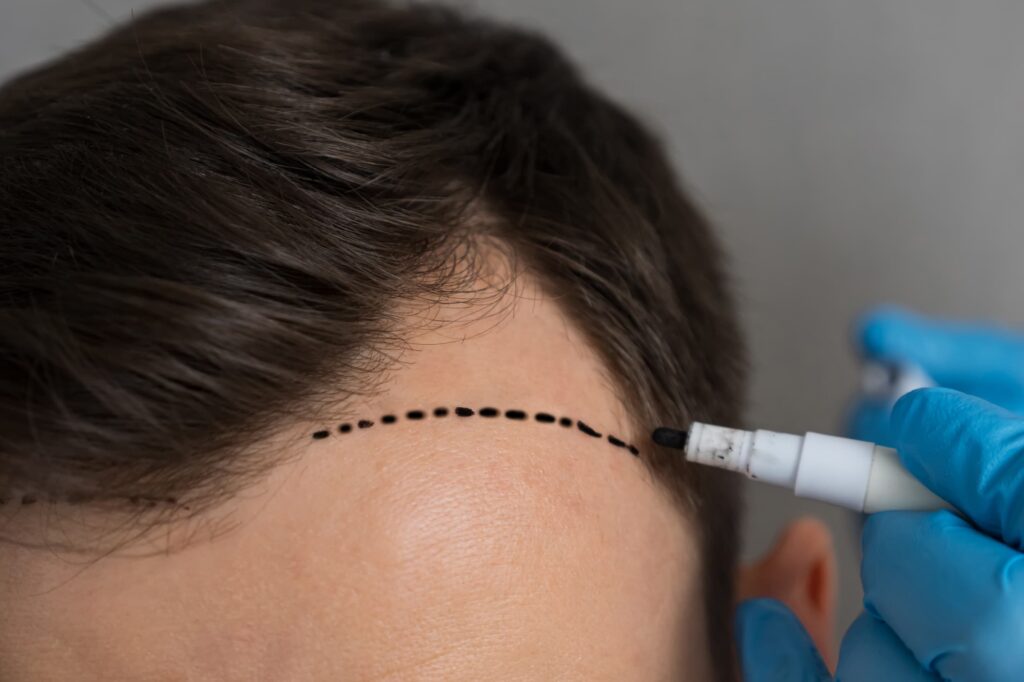
As a born surgeon, I am a big fan of definitive and effective therapies. The process of harvesting and placing 1000 individual hairs is daunting to me, and the wait for growth leaves a lot to be desired. Especially for patients with limited focal areas of balding, scalp reduction can be very satisfactory, takes much less time, and sometimes even costs less than transplants. The results are immediate and the downtime is more tolerable. This approach can also be used for bare areas that are the result of trauma or prior surgery, and with a very high success rate. So why don’t we hear more about it?
The only answer that I can come up with for this question is that, as with many other things, procedures that are considered non-surgical often get more airtime and seem more accessible. People shy away from things labeled as “surgery” when it comes to hair in particular. But if you take the time to step back and consider the options objectively, weighing an entire day face-down while being repeatedly injected and punctured, vs. a one-hour procedure under sedation after which you wake up from the nap and walk home with a brand new hairline, things start to look a little different.
